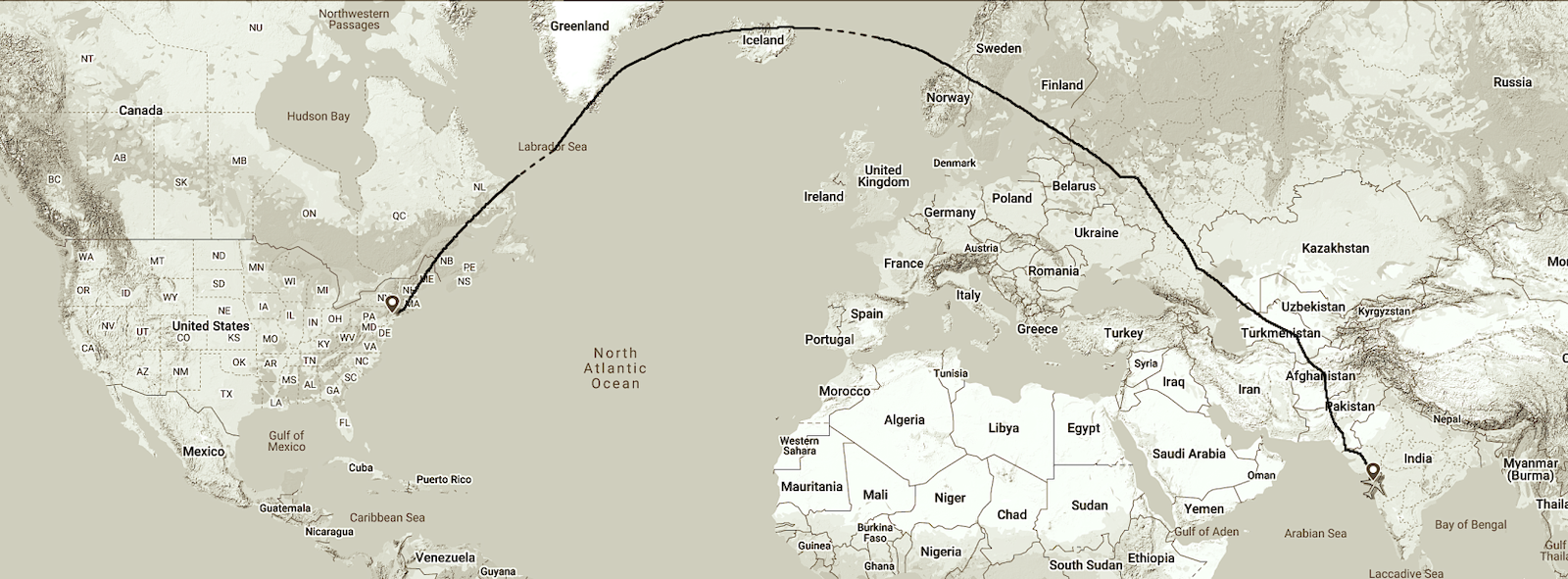
Earlier this year, in January 2021, I moved from New York City to Mumbai, India in the middle of still-ongoing COVID-19 pandemic. This decision took some by surprise, and elicited quite a response on LinkedIn - the most common question being, Why?
So, here's my story and things I learned, for those who are curious and those who are contemplating a similar move halfway across the world.
The Backstory
I grew up in Mumbai, and as many thousand engineering students in India do, decided to pursue my Masters degree in the US. When I went to the US Consulate to apply for my visa, they asked the standard question they ask everyone- "why do you want to go to the United States?" and I gave the standard answer everyone gives- "to learn new things and come back to use this knowledge back here in India". Everyone is coached to say this because when you apply for a non-immigrant student visa, it can be rejected if you show "intent of immigration". However, in my case, this was genuinely my reason, though most people at that time dismissed it off as wishful thinking.
Fast forward ten years, I had graduated, gotten a job, got laid off from a job, gotten a better job, moved to an even better job, lived in three cities across the US, learned a ton of cool things at some of the most amazing tech companies, and was living a comfortable fun life in New York City as a Solutions Architect at AWS. I still had my original desire in the back of my mind but was not actively working on it yet. And then, in early 2020, The Pandemic happened.
Step 1 of moving: Line up a job
When New York City got hit hard by COVID-19 relegating everyone to working from home alone for months, it gave me a lot of time to think about what is really important in life. For me, it was my family, and wanting to work on something satisfying. A big advantage of working at AWS is that it is a truly global company, and moving internally to pursue your passion is encouraged. So I started looking at opportunities in India that would fit my qualifications and my passion. In late 2020, I found a great opportunity in my hometown of Mumbai that fit the bill. This was perfect from both my professional and personal interests so I decided to take the plunge and applied for it, interviewed, and got the job.
This is my biggest takeaway for anyone considering an international move, especially to a country like India where the competition for jobs is intense. If you can move while staying with your existing employer, it makes the process extremely smooth and less stressful. Do not move on a whim without a job or a business lined up, you will spend sleepless nights.
Step 2: Preparing to move out
Moving houses is annoying, all the more if you have to do it in the middle of a pandemic in cold winter. I was given an option to ship all my furniture to India, but it would take about 3 months to arrive by sea, so I decided to give up on most things in my apartment (mostly Ikea stuff) except things of sentimental value, and start fresh in India buying locally manufactured furniture. This is when I discovered an unexpected gem- the Buy Nothing Project. I grudgingly logged in to my dormant Facebook account just for this and within three weeks, I was able to give away pretty much everything without having to step out of my apartment, and ended up with the satisfaction of knowing that none of my things went to a landfill, instead they found new loving homes.
The other fun part of moving is to figure out the actual move. Since I was moving during significant travel restrictions, I chose to pick the non-stop flight from Newark to Mumbai. This is when you discover that baggage fees on international flights is daylight robbery. Despite booking a Business class ticket (courtesy of my unused-since-a-year Chase points), United charges $200 for each extra bag! As a part of my relocation package, Amazon set me up to stay at a hotel for my last three nights in New York City, and I will absolutely recommend this to anyone moving to a new city. It makes life so much easier to be able to clean out and give up your apartment without having to scramble until the last minute. Instead, I spent my last 48 hours reliving my favourite places and foods of NYC and give the city a proper farewell.
Step 3: Settling into a new country
My experience of settling in was rather unique given the circumstances. At that time, India required all international arriving passengers to quarantine at home for 14 days, so I spent my first two weeks in Mumbai living in exile of sorts. I was fortunate to be moving to my family home so I did not have to search for an apartment immediately on stepping into a new country, and once again, I will highly recommend taking this approach if you have the choice. Setting up a new place is where Amazon (the retail site) comes to save the day. Since I was not allowed to step out, I decided to buy almost everything I needed from Amazon, and contrary to some misconceptions, I ended up finding a wide variety of lovely things from across the country- bedsheets from Gujarat, coffee table from Karnataka, rugs from Uttar Pradesh, all delivered to my doorstep, thus giving me the satisfaction of supporting local small businesses across the country whom I would have never found otherwise.
The real challenge of settling in a new country is setting up the adulting necessities. This is where the fun begins. India heavily uses UPI - a cross-platform digital payment interface that is now the de-facto mode of transactions online and in-person. To set up UPI, I would need an Indian bank account. To open a bank account, I would need an Indian phone number. To get a phone SIM, I would need an Aadhar card. Luckily, I had gotten my Aadhar made during a previous visit to India and if you are ever planning to move to India, please get your Aadhar made in advance. Now, time to do the entire process in reverse- associate my new phone number with Aadhar, then associate Aadhar with bank account, then associate bank account with UPI. This dance took a couple of weeks, but once it is set up things are absolutely smooth in the new Digital India. I have not used cash in weeks nor had to visit a bank in-person even once after the initial setup.
So, What's Different?
The inevitable question. Short answer- a lot. Long answer- here is a list in no particular order-
- The food is better, obviously. From home-cooked traditional items to my favourite fast food brands doing a local twist on their menu, India wins over US hands down here. That being said, I will be forever thankful to you if you can get me some NY-style bagels or a Chipotle burrito here.
- Cost of healthcare is not a ripoff, this is a big deal coming from the US. I was used to paying large premiums for health insurance and yet paying a hefty co-pay every time seeing a doctor, and I am paying zero for it here (insurance is not always necessary, though my employer still offers it and pays 100% of the premiums)
- All the usual entertainment subscriptions are available and are much cheaper- Netflix, Amazon Prime, Spotify, you name it.
- Traffic is still terrible. Recently India has invested a ton in improving road infrastructure and the new highways are excellent, but the driving behaviours have not changed so it can take a while to get used to the chaos where signals and lanes are mostly for decor.
- Cars are a few years behind in technology and features. Things assumed standard in the US such as airbags and cruise control are still considered premium add-ons, and I am having quite a time finding a car that meets the level of comfort and safety I am used to, without breaking a bank.
- Pollution and dust is worse. My nose complains every time I have to step out, but wearing a mask all the time has had an unexpected benefit in this department currently.
- Work hours are longer and not always followed. Unlike the US 9-to-5 routine, in India we work more of 10-7ish, and some meetings linger on long beyond the scheduled end time because people don't always respect time boundaries.
- My favourite one so far- becoming a bilingual at work. It has been both fun and challenging to learn to have technical conversations about cloud computing and troubleshooting networking issues in a mix of Hindi and English! People will switch between languages mid-conversation so I have adapted to doing the same.
In Conclusion...
The entire process of moving from the US to India after spending a decade there has been a great learning experience, and a positive one at that for me. If you are one of those who moved to the US like me, and are now thinking about moving back to your home country but hesitant about it, I hope this story has given you some perspectives. There is a lot of opportunity to contribute to the economic growth and play a satisfying role in helping unleash the potential of developing countries today. If your heart feels like it, take the plunge, and make that statement you gave during your visa interview a reality!